
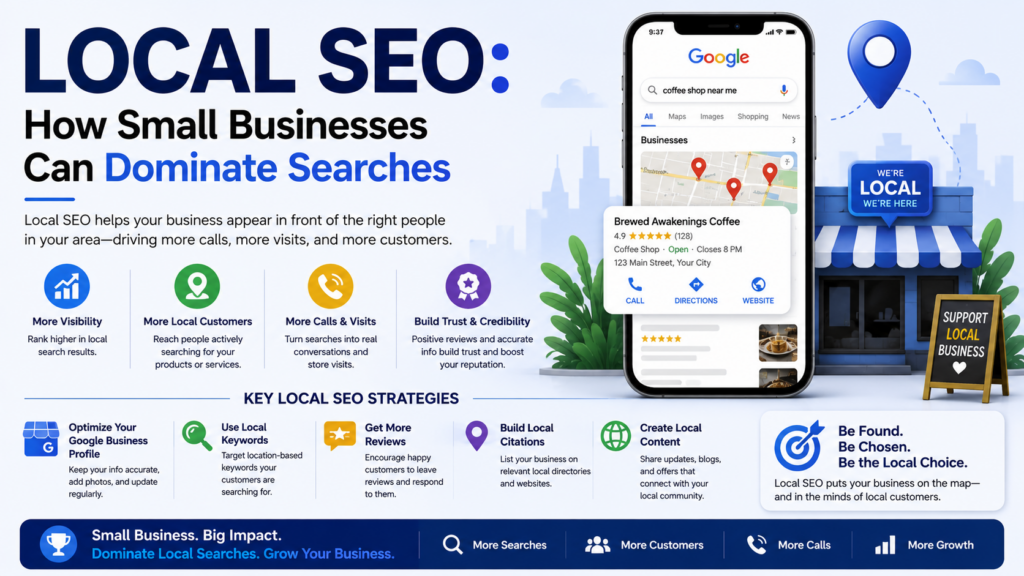
If your business serves a specific city, neighborhood, or region, local SEO might matter more to your growth than general SEO ever will. When someone searches “plumber near me” or “best coffee shop in [city],” Google isn’t just showing the highest-ranking website overall it’s showing the most relevant, trustworthy business nearby. Here’s how to make sure that business is yours.
What Is Local SEO?
Local SEO is the practice of optimizing your online presence to attract more business from relevant local searches. It’s what determines whether you show up in Google’s “Local Pack” (the map and three-listing block that appears above regular search results) and in “near me” queries.
It matters most for businesses like:
- Restaurants, cafes, and retail stores
- Service providers (plumbers, electricians, salons, clinics)
- Law firms, real estate agents, and other local professionals
- Any business with a physical location or a defined service area
1. Claim and Optimize Your Google Business Profile
Your Google Business Profile (formerly Google My Business) is the single most important local SEO asset you have. To optimize it:
- Fill out every section completely: categories, hours, services, and attributes
- Add high-quality photos of your location, products, or team
- Keep your business name, address, and phone number (NAP) accurate and consistent
- Post regular updates, offers, or announcements through the profile
- Respond to every review positive or negative professionally and promptly
An incomplete or inactive profile is one of the most common reasons local businesses lose visibility to competitors.
2. Keep Your NAP Consistent Everywhere
NAP consistency (Name, Address, Phone number) across your website, Google profile, social media, and any directory listings (Yelp, Yellow Pages, industry-specific directories) is a major trust signal for search engines. Even small inconsistencies like “St.” in one place and “Street” in another can create confusion that hurts your rankings.
3. Get Genuine Customer Reviews
Reviews influence both rankings and consumer trust. A steady stream of recent, genuine reviews signals to Google that your business is active and well-regarded. Practical ways to encourage reviews:
- Ask satisfied customers directly, in person or via follow-up email/text
- Make it easy with a direct link to your review page
- Never buy or fake reviews it violates platform policies and can seriously damage trust if discovered
4. Build Location-Specific Content
If you serve multiple areas, create dedicated pages for each location rather than one generic page trying to cover everything. Each page should include:
- Unique, genuinely useful content about that specific location
- Local landmarks, neighborhoods, or context relevant to that area
- Location-specific testimonials or case studies where possible
Avoid simply duplicating the same page and swapping out city names — search engines can identify this and it rarely performs well.
5. Earn Local Backlinks
Backlinks from other local businesses, organizations, or media outlets carry strong local relevance signals. Consider:
- Sponsoring local events or charities
- Partnering with complementary local businesses for cross-promotion
- Getting featured in local news, blogs, or community websites
- Joining your local chamber of commerce and relevant local directories
6. Optimize for Mobile and Voice Search
Most “near me” searches happen on mobile devices, often through voice search. Make sure your site loads quickly on mobile, has clickable phone numbers, and provides clear, easy-to-find directions and hours. Structuring content in a natural, conversational way also helps with voice search queries, which tend to be longer and more question-based than typed searches.
7. Use Local Keywords Strategically
Incorporate location-specific keywords naturally into your titles, headers, meta descriptions, and body content for example, “affordable web design in Austin” rather than just “affordable web design.” Avoid keyword stuffing; the goal is natural, helpful content that happens to include the terms your local customers are actually searching for.
Measuring Local SEO Success
Track these metrics to gauge how well your local SEO is performing:
- Google Business Profile views, clicks, and direction requests
- Local Pack rankings for your target keywords
- Website traffic from local searches
- Number and quality of new customer reviews
Final Thoughts
Local SEO rewards consistency, authenticity, and genuine community presence over shortcuts. A complete Google Business Profile, consistent NAP information, real customer reviews, and location-specific content will do more for your visibility than any quick trick. Start with the fundamentals, stay consistent, and your local search presence will grow steadily over time.
Not sure where you stand locally? Search your own business name and a few relevant “near me” terms to see exactly what your potential customerss