
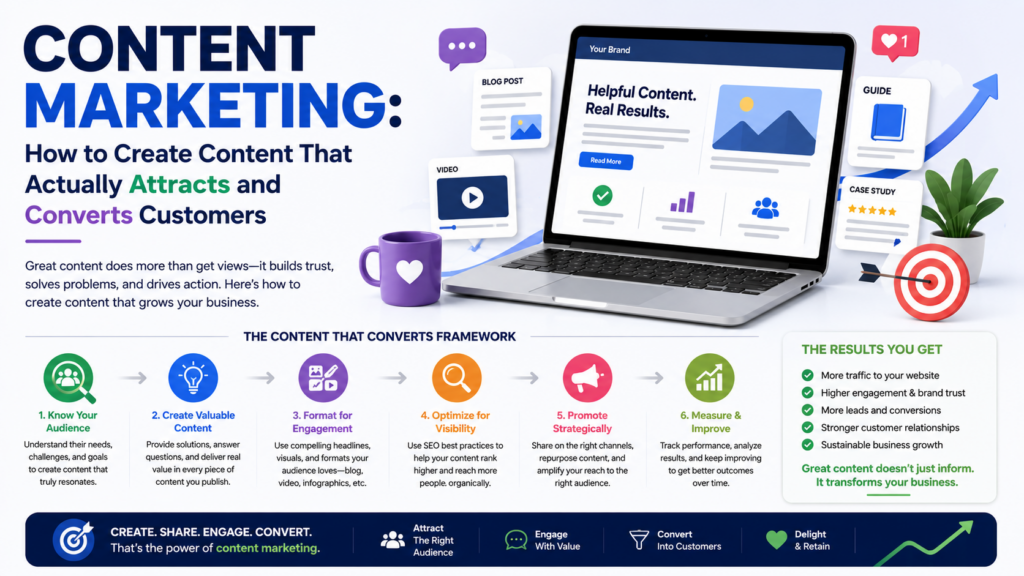
Content marketing is one of the most cost-effective ways to build trust, attract organic traffic, and turn casual visitors into paying customers. But not all content performs equally the difference between content that drives real results and content that goes unnoticed usually comes down to strategy, not just effort. Here’s how to build a content marketing approach that genuinely moves the needle for your website.
What Is Content Marketing?
Content marketing is the practice of creating and distributing valuable, relevant content blog posts, videos, guides, podcasts, infographics to attract and retain a clearly defined audience, ultimately driving profitable customer action. Unlike direct advertising, it doesn’t pitch your product outright; it earns attention and trust by being genuinely useful first.
1. Start With Your Audience, Not Your Product
The most common content marketing mistake is writing about what a business wants to say rather than what its audience actually wants to know. Before creating anything, get clear on:
- Who your ideal customer is and what problems they’re trying to solve
- What questions they’re already typing into search engines
- Where they are in their buying journey (just learning, comparing options, ready to buy)
Content that directly answers a real question or solves a real problem will consistently outperform content built purely around promoting your product.
2. Build Around Topic Clusters, Not Random Posts
Instead of publishing disconnected, one-off blog posts, organize your content around core topics relevant to your business often called topic clusters or pillar content. A central “pillar” page covers a broad topic comprehensively, while supporting posts dive deeper into specific subtopics and link back to the pillar page.
This approach helps with SEO by signaling topical authority to search engines, and it helps readers naturally discover more of your related content.
3. Diversify Your Content Formats
Different people prefer to consume content differently. A strong content strategy usually includes a mix of:
- Blog posts and guides great for SEO and answering specific questions in depth
- Video highly engaging and increasingly favored by search and social algorithms
- Infographics effective for simplifying data or processes into a shareable visual
- Case studies build trust by showing real results with real customers
- Podcasts or interviews build a loyal, engaged audience over time
You don’t need to do everything at once pick one or two formats you can execute well and expand from there.
4. Focus on Quality and Depth Over Volume
Publishing frequently used to be enough, but today, thin or generic content rarely performs well — both with readers and with search engines. A single, thorough, genuinely useful piece of content will typically outperform five shallow posts covering the same ground. Aim for content that:
- Answers the reader’s question completely, without requiring them to look elsewhere
- Includes specific examples, data, or original insight rather than generic statements
- Is well-organized with clear headings so readers can scan and find what they need
5. Repurpose Content Across Channels
Great content doesn’t need to be created from scratch for every channel. A single in-depth blog post can be repurposed into:
- A short video summary for social media
- A carousel or infographic for Instagram or LinkedIn
- An email newsletter segment
- Several standalone social posts highlighting key points
This maximizes the return on the time invested in your best content, rather than treating each piece as disposable.
6. Keep Older Content Alive
Content marketing isn’t just about publishing new material refreshing and updating older content is often one of the highest-ROI activities available. Revisit your best-performing older posts periodically to:
- Update outdated statistics, examples, or screenshots
- Improve structure, headings, and readability
- Add new sections addressing questions readers are now asking
This can meaningfully improve rankings and traffic without the cost of creating something entirely new.
7. Measure What Actually Matters
Track metrics that reflect real business impact rather than just vanity numbers:
- Organic traffic and time on page
- Conversion rate from content (sign-ups, inquiries, purchases)
- Search rankings for target topics
- Content shares and backlinks earned
Use this data to double down on the topics and formats that are genuinely working, and phase out approaches that aren’t.
Final Thoughts
Effective content marketing isn’t about publishing constantly it’s about consistently creating genuinely useful content built around what your audience actually needs, organized in a way that builds authority over time. Start with your audience’s real questions, go deep rather than wide, and give your best content room to keep working for you long after it’s published.
Want a quick starting point? List the five questions your customers ask most often before buying those are your next five pieces of content.