
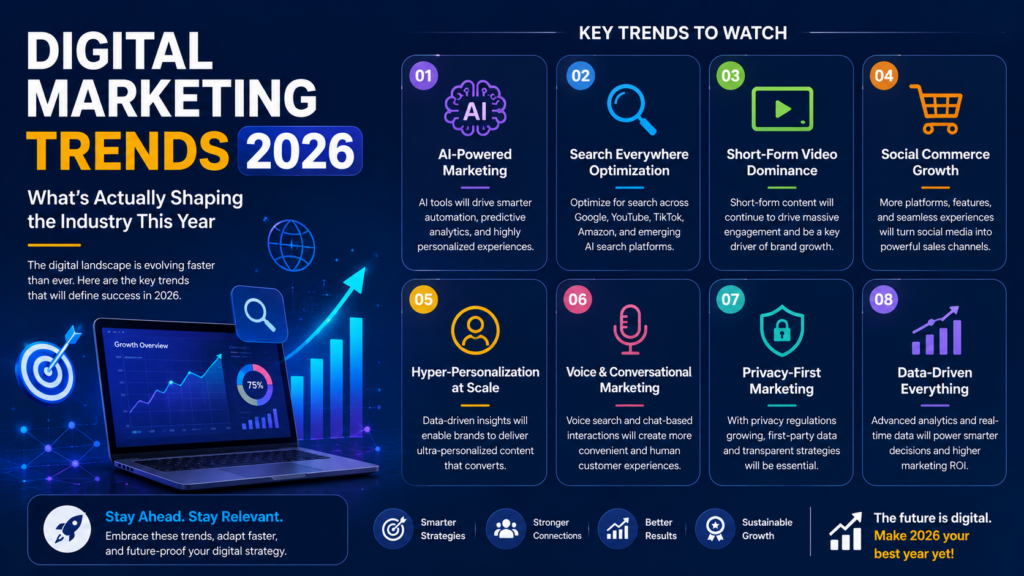
Digital marketing is moving faster than ever, and 2026 is proving to be a turning point rather than just another incremental year. AI has moved from a niceto have tool to a strategic layer running through nearly every part of the marketing process, while shifting privacy rules, changing search behavior, and new consumer expectations are forcing brands to rethink how they show up online. Here’s a look at the trends actually defining digital marketing this year and what they mean for your website and overall strategy.
1. AI Moves From Automation to Strategy
AI is no longer just about automating repetitive tasks. It’s become a core part of how campaigns are planned, personalized, and optimized in real time analyzing customer behavior, generating content variations, and adjusting targeting on the fly. The role of the marketer is shifting too: instead of just executing tasks, marketers are increasingly expected to interpret AI driven insights and make strategic calls based on them. The advantage now goes to teams who know how to direct these tools thoughtfully, not just use them.
Agentic AI is also emerging as a bigger theme autonomous systems capable of handling multi-step workflows, like managing a campaign from planning through execution with minimal manual intervention.
2. Personalization Is No Longer Optional
Consumers increasingly expect brands to know them and they respond accordingly. Personalized content, product recommendations, and messaging tailored to individual behavior are becoming baseline expectations rather than a bonus feature. Businesses that lean into data-driven personalization across email, website content, and ads are seeing meaningfully better engagement and conversion than those using generic, one size fits all messaging.
3. Search Behavior Is Fragmenting
Traditional search engines are no longer the only or even the first place people go to discover new brands. Social platforms, communities, and recommendations are increasingly where discovery happens, with search often used afterward to validate a decision rather than start the journey. This means your SEO strategy in 2026 needs to account for visibility across social search, AI-powered answer engines, and traditional search results not just Google rankings alone.
4. Short-Form and Shoppable Video Keep Growing
Short-form video remains a dominant content format, but 2026 is seeing it evolve further with shoppable video where viewers can purchase directly within the content itself, especially on connected TV (CTV) and streaming platforms. What used to be a brand awareness format is increasingly becoming a direct sales channel, blurring the line between content and checkout.
5. Social Commerce Continues to Expand
Buying directly through social platforms is becoming a normal part of the customer journey rather than a novelty. Combined with rising creator influence, brands are finding more success partnering with creators for authentic promotion than relying solely on traditional ads.
6. Authenticity and Trust Are Currency
With AI generated content becoming more widespread, audiences are placing a higher premium on content that feels genuinely human. Brands that lean into transparency, real customer stories, and authentic behind the-scenes content are standing out precisely because so much of the content landscape now feels automated or synthetic.
7. Cross-Channel Measurement Is Essential
As ad channels and data sources continue to fragment, measuring the full customer journey across touchpoints has become more complex and more necessary. This is driving renewed investment in approaches like Marketing Mix Modeling (MMM) to understand what’s actually driving results across a scattered media landscape, rather than relying on single-channel attribution.
What This Means for Your Website
If you’re optimizing your own site for 2026, a few practical takeaways stand out:
- Build for AI-assisted discovery make sure your content is structured clearly enough that AI search tools and answer engines can accurately summarize and reference it.
- Double down on authenticity real case studies, testimonials, and behind-the-scenes content will outperform generic, obviously AI-generated copy.
- Treat video as a conversion tool, not just a brand-awareness format think about how product or service pages can incorporate shoppable or interactive video.
- Personalize where you can even simple steps like dynamic content blocks or personalized email flows can meaningfully lift engagement.
- Don’t abandon SEO fundamentals traditional search still matters, especially for validation-stage visitors, so solid on page and technical SEO remain essential.
Final Thoughts
2026 isn’t about chasing every new tool or platform it’s about understanding how audience behavior is genuinely shifting and adapting your strategy accordingly. AI, authenticity, and cross-channel thinking are the through-lines connecting nearly every trend this year. Brands that combine strong fundamentals with a willingness to experiment will be best positioned to grow.
Want help auditing your current strategy against these trends? Start by reviewing your last quarter’s top-performing content and asking which of these shifts it already reflects and where the gaps are.